
Summable and Nonsummable Metrics
With a few exceptions, every metric on Clarisights is aggregated in one of two ways: as a summable or a non-summable metric.
Summable Metrics
Metrics such as cost, clicks and impressions are aggregated by summing them across the chosen time range. This covers essentially all metrics that involve no calculation and are imported directly from the data source.
For example, if you are looking at the metric AW: Cost across two dimensions, date and city, then the aggregate of AW: Cost is calculated as the sum of the values of each of these rows.

Non-Summable Metrics
Metrics such as CTR, CPC and CVR involve a calculation over base, summable metrics. They are aggregated in three steps:
Break the metric down into its base constituent metrics.
Calculate the aggregate of each base metric.
Perform the calculation on those aggregates.
For example, in the case of AW: CTR being aggregated across date and city, it is broken down into its constituent metrics, in this case AW: Impressions and AW: Clicks which are in-turn summable metrics. The aggregates of each of these is computed first, and then those aggregates are used to calculate the aggregate of AW: CTR.

Exceptions
Two notable exceptions are covered below. There may be other exceptions that are not listed here.
Realtime metrics
Some metrics can't be aggregated from the data Clarisights has, and must be aggregated by the data source itself. FB: Reach is an example. It counts the unique people reached by a given ad, ad set and so on. Clarisights doesn't know which unique people saw several of the selected ads or ad sets, so it can't aggregate Reach across them.
For these metrics, Clarisights pulls both the individual values and the aggregate directly from the data source, based on the dimensions and time range chosen in the widget.
Note: realtime metrics are queried from the API in real time, so widgets that include them load more slowly than usual. Custom metrics based on realtime metrics don't work.
Weighted sum metrics
In Clarisights, you can define a special kind of custom metric called a "weighted sum". For example:
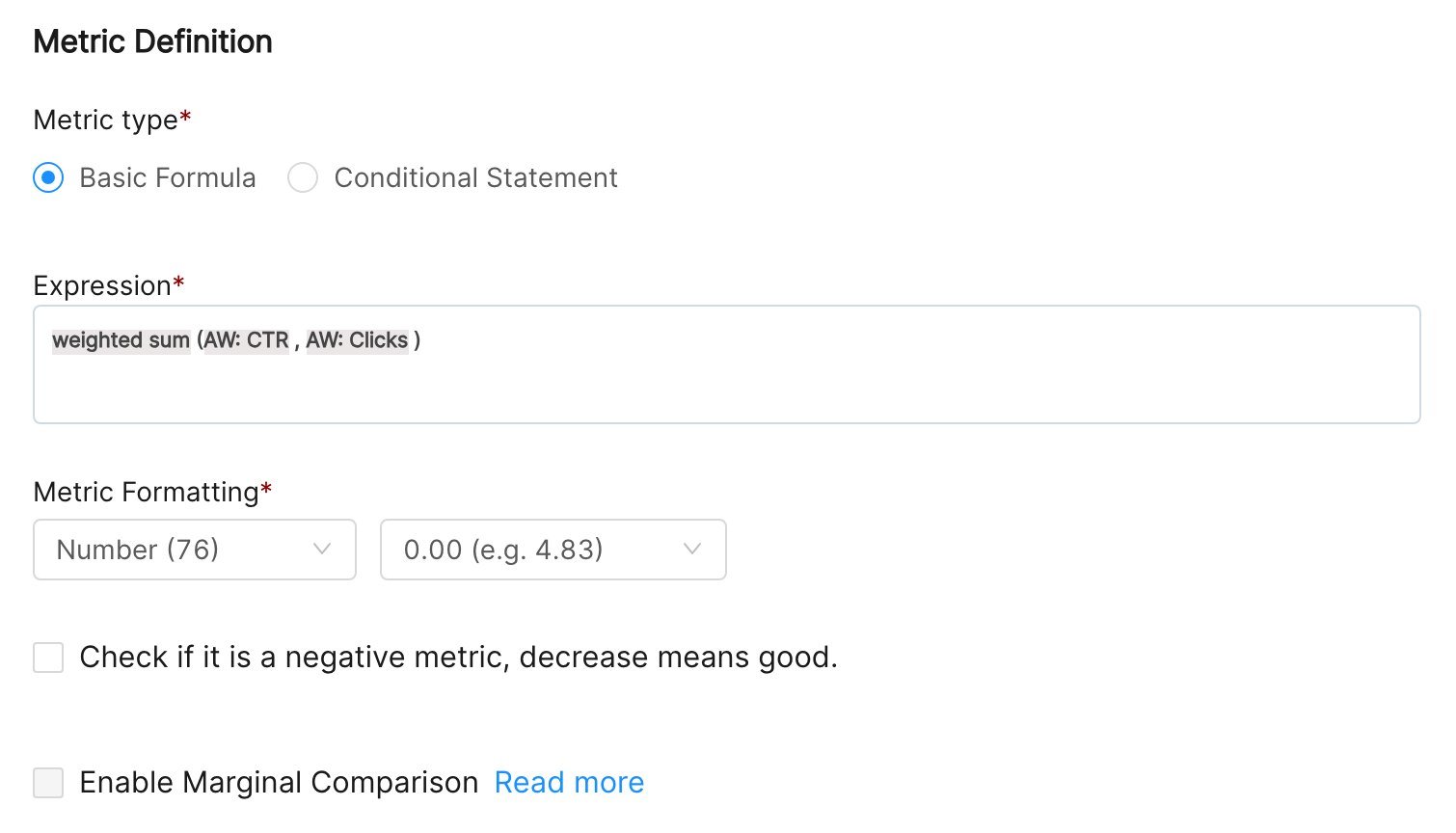
To be accurate, a weighted sum has to be calculated for each unique row of data. Clarisights therefore:
Splits the two constituent metrics by object and date.
Calculates the product of the constituent metrics for each unique object and date.
Adds up all of those products to show the aggregate weighted sum.
In the example below, Weighted Sum Sample is not simply the product of AW CVR and AW: Clicks. It is the sum of the products of these two metrics per object per day.

Note: in Clarisights, all metrics are stored against entities called "objects". Each item at a given level is one object. For example, each distinct campaign in Facebook is an object at campaign level, and each distinct ad group in Google Ads is an object at ad group level. When you look at data for a group of objects (for example, a custom dimension "Country" defined at campaign level), you are looking at the aggregate data of all the objects (here, campaigns) tagged with each Country.